
Science Camp Curriculum
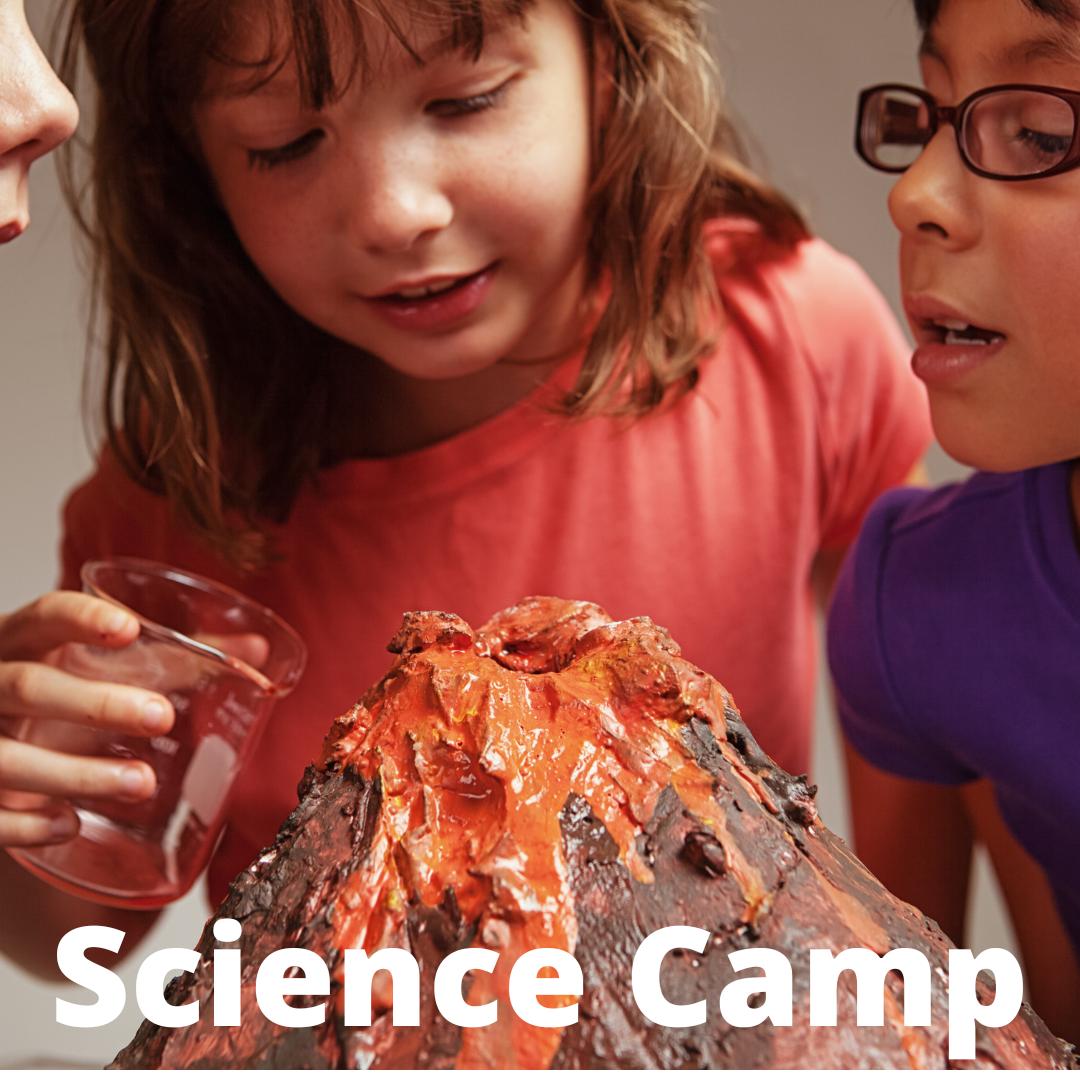
EQUIPMENT
All Campers
Week at a glance
| Day | Anchor Experiment | Co-Activity | Take-Home | Wow Moment |
|---|---|---|---|---|
| Mon | Mini Volcano build + chemical eruption | Eruption Lab — ratio experiments | Volcano + baking-soda refill packet | Color-foam eruption |
| Tue | Balloon Rocket on string line (Newton's 3rd Law) | Paper Stomp Rocket race | Balloon rocket kit + stomp rocket | Rocket race distance winners |
| Wed | Sink-or-Float predictions + Foil Boat + Penny Load Test | Cargo Boat Olympics | Foil boat + Boat Designer journal page | Boat holds 30+ pennies |
| Thu | Mystery Radish Seed planting in clear cup | Walking Rainbow + Color-Changing Celery (overnight) | Planted cup + dyed celery + Plant Care Card | Friday-morning sprout at home |
| Fri | DIY Lava Lamp + GALLERY DAY for parents | Glow Paint mini canvas | Lava lamp + glow canvas + Scientist Journal + pizza-box gallery | Bubbling lava + glow-in-the-dark reveal |
Every day pairs an anchor experiment with a co-activity that finalizes the take-home, so campers never sit idle and every kid is pickup-ready by 11:30 AM with something a parent can see and ask about.
📓 The Scientist Journal — Spine of the Week
Every camper gets a printed Scientist Journal on Day 1. They decorate the cover Monday, write in it every day, and take it home Friday inside the pizza-box gallery kit.
- Format: ~20 pages, printed double-sided on 10 sheets of 8.5"×11", top-stapled. ~$0.30/journal.
- Page-per-day cadence: every day gets ~3 pages (drawing + data table + reflection). Plus cover, Scientist Pledge, "What I learned this week" reflection, "Real Scientists I Know," counselor-signed back-cover certificate.
- Why it matters: replaces the legacy standalone Eruption Lab Card, Seed Observation Card, Boat Designer Card, and Lab Notebook with ONE unified artifact. Continuity across days. The Friday gallery-walk centerpiece for parents.
- Counselor scripts in each day section below cite specific journal page numbers at every block.
What progresses across the week
- Domains of science: chemistry (volcano) → physics (rocket) → engineering (boat) → biology (plant) → chemistry + light (lava lamp + glow)
- Take-home reusability: one-time wow (volcano) → reusable kit (rocket) → keepsake (boat) → living thing (plant) → display piece (lava lamp + glow canvas)
- Energy curve: high (Mon eruption) → very high (Tue rockets) → high + messy (Wed water) → calm + focused (Thu plants) → wow + ceremonial (Fri gallery)
- Friday is "Gallery Day." Parents arrive 5 min early for the family science gallery walk — every camper's work from the whole week comes out for the mini-show.
Daily photo moment (consistency for parent socials)
Same photo wall every day (corner of the room with a "GrowFit Science Lab" sign + plain backdrop). Take both:
- Individual — camper holding today's take-home, big smile.
- Group — themed daily salute:
- Mon — Volcano Roar: hands curled like claws, biggest "RAWR!"
- Tue — Rocket Launch: crouch low, then leap with arms straight up
- Wed — Boat Captain: hand to forehead in a salute
- Thu — Plant Scientist: stand still as a tree, arms branching out
- Fri — Glow Squad: lights off, flashlight from below, glow canvas held in front
Counselors upload both to a daily folder by 12:15 PM for Russ to push to socials.
🛡️ Hard safety rules across the week
- No borax at any camper station any day. (Replaces the legacy site's bouncy-ball recipe.)
- No raw contact lens solution (contains boric-acid preservative).
- Alka-Seltzer on Day 5 is fine for ages 6+ supervised. Safety call-out: "the tablet is not candy — never put in your mouth."
- Latex check for Tuesday balloons: pre-confirm at sign-in; non-latex foil balloon backup for any kid with confirmed latex allergy.
- Spill containment Wednesday: heavy-duty Sterilite bins on plastic-sheeted floor; towel ring around each bin.
- Seed allergy check Thursday: confirm at sign-in. Radish seeds are very low-allergy but treat any tree-nut/seed allergy with caution.
- Vinegar (Day 1) and food coloring (Days 1, 4, 5): mild irritants. Gloves available at every station. Hand-washing built into every transition.
- No tasting science. Repeated at the start of every day and at the snack break.
Counselor pre-camp checklist (Sunday night before Week 1)
- All material totes inventoried against
ordering-spec.md - Counselor demo of each day's anchor experiment completed and photographed for the camp room wall
- Photo wall set up + "GrowFit Science Lab" sign printed
- Scientist Journals printed, stapled, and stacked — 20 journals (16 campers + 4 spares). Print Sunday night, top-staple, stash in a labeled bin
- Parent take-home printables (one per day) printed for the full week, divided into daily envelopes
- Allergy/sensitivity list reviewed; alternate-recipe ingredients shelved separately and labeled
- Tue (rocket day): test-fire the stomp rocket launcher outdoors to verify it works
- Wed (boat day): confirm spill-containment supplies are at the site (extra plastic sheeting, towels)
- Thu (plant day): radish seeds purchased fresh (within 1 year of pack date); soil pre-bagged into camper portions; celery purchased Wed evening from local grocery
- Fri (gallery day): pizza boxes labeled and stacked; flashlights tested
📅 DAY 1 — MONDAY: Mini Volcano Build + Eruption Lab ← click to expand
Theme: Volcano Day — Earth Chemistry Lab Wonder Question: "What if you could build a real-feeling volcano on your table — and make it ERUPT… using stuff from your kitchen?" Take-home: Painted clay volcano (reusable for at-home eruptions) + sealed packet of baking soda for the next eruption + "Eruption Recipe Card" + Scientist Journal (stays at camp through Friday — goes home in the pizza-box gallery kit) Photo moment: Group "Volcano Roar" — both hands curled into claws, biggest roar, volcano held in front
🧠 Learning goals & SEL focus
- Science: chemical reactions (acid + base → CO₂ gas), Earth science (real volcanoes, pressure, magma), prediction and observation
- Vocabulary in kid words: acid (vinegar = sour), base (baking soda = bitter), gas (the bubbles!), reaction (when two things make a new thing happen)
- SEL: following a multi-step recipe carefully, controlled excitement (waiting your turn to erupt), curiosity through "what if we tried…"
🛠️ Materials per camper (group of 16)
Anchor — Volcano Build:
- 1 small disposable plastic cup (3–4 oz) per camper (volcano's "chamber")
- ~½ cup air-dry clay or salt dough per camper (Crayola Air-Dry Clay or homemade — counselor cheat sheet for recipe)
- 1 plastic plate or 8" cardboard round per camper (volcano base)
- 1 wooden craft stick (sculpting tool)
Anchor — The Eruption:
- 2 tbsp baking soda per eruption (each kid gets 2 eruptions today = 4 tbsp per camper)
- ¼ cup white vinegar per eruption, pre-portioned into small condiment cups
- 1 squirt dish soap per eruption (makes thicker, longer-lasting foam)
- Liquid food coloring (red, yellow, orange, green) — 2 drops per eruption, camper picks
- 1 pipette or small medicine cup per camper for adding vinegar in a controlled way
Co-Activity — Eruption Lab:
- Scientist Journal page 3 (data table — 3 ratio tests, filled in live; replaces the legacy standalone "Eruption Lab Card")
- Extra small cups + measuring spoons (¼ tsp, ½ tsp, 1 tsp) at the lab station
Journal (the spine of the week):
- 1 Scientist Journal per camper (printed + stapled Sunday night) — distributed today, decorated cover today, used every day, goes home Friday
- Crayons or thin markers at every station for cover decoration + drawings
- Sharpie or pencil at every station for writing data
Take-home:
- 1 ziplock snack baggie per camper, pre-filled with ~3 tbsp baking soda + "ERUPTION REFILL" sticker
- Printed Eruption Recipe Card
- 1 brown paper grocery bag per camper (named) — fits volcano + refill + card
Counselor / shared:
- Heavy-duty plastic tablecloths on every table (mandatory — vinegar can damage finishes)
- Large plastic trays under each volcano during eruptions (catches overflow)
- Acrylic paint + brushes (for decorating the volcano after the clay base is built)
- Paper towels (1 roll per table)
- 3 demo volcanoes pre-made + pre-painted the night before for the quality bar
- "GrowFit Science Lab" photo wall
⏰ Schedule
9:00 – 9:15 | Welcome + Theme Hype + Wonder Question + Journal Handout (15 min)
- Counselors greet at the door with high-fives. At each spot: stapled Scientist Journal with the camper's name on the front in Sharpie.
- Counselor hype:
"Welcome to the GrowFit Science Lab! This is the week you become a REAL SCIENTIST. Today is VOLCANO DAY. We are going to BUILD a volcano with our hands… and then we're going to make it ERUPT. Twice. With science. Are you ready?"
- Wonder Question: "What if you could build a real-feeling volcano on your table — and make it ERUPT… using stuff from your kitchen?"
- Show a demo volcano. Trigger an eruption right now in front of them (hooks the room). "By 11:30, every one of you has this. Two eruptions today, and a refill packet to take home for a THIRD eruption with your parents."
- Journal handout (4 min): "This is YOUR Scientist Journal. You're going to write in it every day this week. Right now — flip it over to the COVER. Draw YOURSELF as a scientist. Lab coat, goggles, wild hair, anything. You have 3 minutes. Fill the whole box."
- Scientist Pledge (2 min): counselor reads page 1 aloud; every camper writes their name and signs the bottom. "You are now officially scientists."
- Safety contract (60 sec): "Vinegar stays in the cup. No tasting. No rubbing eyes. Hands washed before snack."
9:15 – 9:35 | Warm-up: Real Volcano Show + "Acid or Base?" Game (20 min)
- First 10 min — Real Volcano Slideshow: counselor shows 4–5 quick images of real volcanoes (printed cards or projected if site has a screen): Mount St. Helens, Hawaii, an underwater volcano, Yellowstone's "volcano" caldera. Quick facts ("This one is still steaming RIGHT NOW.")
- Last 10 min — "Acid or Base?" Game: counselor calls out a household item. Kids guess "ACID!" (yell + thumbs down) or "BASE!" (yell + thumbs up). Items: lemon (acid), soap (base), vinegar (acid), baking soda (base), milk (slightly acid), juice (acid), toothpaste (base), apple (acid).
- Counselor seal: "Today's eruption is what happens when ACID meets BASE: they make gas, and the gas pushes everything UP."
- Younger camper (6–7) tip: counselor calls items + lets kids copy the answer of the kid next to them on the first round.
- Older camper (8–9) stretch: add "Why?" — "Why is vinegar an acid?" (it's sour) — light pH conversation.
9:35 – 10:15 | Anchor Part 1: Build the Volcano (40 min)
- Counselor demos at the front (5 min):
- Put the small plastic cup in the center of the plastic plate.
- Take the clay/salt dough and press it AROUND the cup, building UP into a cone shape. Leave the cup opening at the top exposed (the "crater").
- Use the craft stick to make grooves down the sides (lava rivers, cracks, texture).
- Campers build for 20 min. Counselors circulate. Cue: "Don't seal the top — we need to drop stuff IN there!"
- Journal beat (5 min before painting): "Open your journal to page 2. Draw YOUR volcano. Give it a name. Write the name on the line." Counselor calls out 3 example names to spark ideas ("Mount Quesadilla, Mount Bubbles, Mount Caleb").
- Last 10 min: paint the dry-ish volcano with acrylic paint (red, orange, brown, black, green for vegetation, blue for water). Paint won't be fully dry by eruption time — that's OK.
10:15 – 10:30 | Snack + Brain-Break: Volcano Charades (15 min)
- All campers wash hands (vinegar is coming next — no acid on snacks).
- Snack at tables (away from the painted volcanoes).
- Brain break: counselor acts out 5 things — exploding volcano, lava flow, earthquake, rising smoke, the "calm before." Campers copy each move.
10:30 – 11:00 | Anchor Part 2: ERUPTION #1 (30 min)
THIS IS THE MOMENT.
- Counselor sets every volcano on a large plastic tray.
- Pass out: baking soda (2 tbsp per kid), food coloring (2 drops), dish soap (1 squirt), vinegar (¼ cup pre-portioned).
- Counselor demo (3 min): at the demo volcano: spoon baking soda in → squirt dish soap → add 2 drops of food coloring → pour vinegar in — STAND BACK!
- Eruption window (15 min): every camper runs the same sequence at their volcano. Counselor walks around with the vinegar bottle, pouring on each camper's count of 3. Kids cheer for each other.
- The "second eruption" reset (12 min): while kids clean up tray foam with paper towels, counselor re-stocks each station with another round of baking soda + soap + coloring + vinegar. Each camper gets to do it AGAIN — this time they pick a different color + try a different amount of baking soda. (Eruption Lab co-activity coming next.)
11:00 – 11:30 | Co-Activity: Eruption Lab — Ratio Experiments (30 min)
This is where the real science learning lands. Campers run their second eruption as a controlled experiment.
- "Open your journal to page 3." Each kid flips to the Eruption Lab data table (3 rows: Try #, baking soda amount, color, eruption size 1–10).
- Campers fill in row 1 from memory (their first eruption from Part 2). Then they run a second eruption with MORE baking soda (e.g. 3 tbsp instead of 2) and rate the size on page 3. Then a third eruption with LESS (1 tbsp). They log every result.
- After the 3rd eruption, they answer the page-3 question at the bottom: "Which try made the BIGGEST? Why?"
- Counselor cue at the end: "Which amount made the biggest eruption? What do you think would happen if we used a WHOLE CUP?" (Lead them to: more baking soda + more vinegar = more gas = bigger eruption. The chemistry has limits.)
- Younger camper (6–7) tip: counselor scribes the journal page; camper does the eruptions and points to the answer.
- Older camper (8–9) stretch: also test what happens if you use HALF the vinegar (smaller eruption). Begin to teach "controlled variables."
11:30 – 11:45 | Gallery Walk + Journal Reflection + Photo Moment (15 min)
- Journal beat (3 min upfront): "Open to page 4. Write ONE thing you NOTICED today and ONE thing you WONDER about. Then write the ONE thing you'll tell your parents at dinner." Counselor circulates.
- All campers stand behind their volcano + open journal at page 4.
- One-sentence share: "My volcano is called ___ and the biggest eruption was when I used ___."
- Photo wall:
- Individual: camper holding the volcano at chin level — chest-up portrait.
- Group: "VOLCANO ROAR!" — both hands curled into claws, biggest roar, volcano held in front. 3 shots.
11:45 – 12:00 | Clean-up Game + Pack Take-Home + Journal Storage + Goodbye Cheer (15 min)
- "Foam Race": pairs race to wipe their tray, ball up disposables, toss into the big trash bag. First pair done = goofy victory cheer.
- Each volcano carefully placed in the named brown bag, along with the refill baggie of baking soda + Eruption Recipe Card.
- Journals stay at camp: counselor collects every journal and stores in the named bin at the lab. (They'll come back out Tuesday morning.) Tell campers: "Your journal stays here all week so it doesn't get lost. You'll get it back home FRIDAY — promise."
- Goodbye cheer: "GrowFit Scientists — DIS-MISSED! Ask your parents for vinegar tonight so you can erupt at home!"
💬 Counselor tips
- The night before: make 3 demo volcanoes AND pre-paint them. Pre-portion baking soda into snack baggies for the take-home refills.
- Salt dough recipe (cheaper than air-dry clay for bulk camps): 2 cups flour + 1 cup salt + 1 cup water — mix until doughy. Cheap, holds shape, paints well, takes 24 hrs to dry fully (won't matter — kids erupt today).
- The "second eruption" is the magic. First eruption is the wow; second eruption is the experiment. Don't skip it.
- Foam goes EVERYWHERE. Plastic trays under every volcano are non-negotiable. Have a trash bag at every table.
- Dish soap = MORE foam. It traps the CO₂ bubbles. Without it, eruption looks weaker.
- If a volcano breaks during the eruption (over-saturated clay): counselor patches with a fresh blob of clay. Continue.
- The take-home refill packet is the cheap-and-thoughtful detail that delights parents. ~$0.05/kid in materials.
- Allergies: vinegar is generally safe but check for any vinegar-sensitive skin at sign-in. Food coloring sensitivity: switch to natural food coloring if any kid has confirmed sensitivity.
🛟 Safety call-out
- Vinegar stays in the cup, the spoon, or the volcano — never near your face.
- No tasting science. Vinegar tastes bad and stings if it gets in your eyes.
- Wash hands before snack. Wash hands before pickup.
- If vinegar splashes in your eye, tell a counselor IMMEDIATELY. Counselor walks them to the wash station and rinses with cool water.
- The clay is not edible.
🎯 Parent take-home card content (printed, in the brown bag)
Your camper built and erupted a VOLCANO today! Inside the bag: their painted volcano + a refill packet of baking soda + this card. Today's science: when vinegar (an acid) meets baking soda (a base), they make CO₂ gas. That gas pushes everything up — same chemistry that makes bread rise and soda fizzy. Eruption #3 at home (with you!): Place the volcano on a plate or in the sink. Pour the refill packet of baking soda into the crater. Add 1 squirt of dish soap + a few drops of food coloring. Pour ¼ cup of plain white vinegar in. STAND BACK! Care: the volcano can erupt 10+ times. Rinse with water between eruptions. Store on a shelf when not erupting. Tomorrow: ROCKET DAY — please send your camper in clothes they can move + run in!
📅 DAY 2 — TUESDAY: Rocket Engineer Day ← click to expand
Theme: Rocket Lab — Newton's 3rd Law in Action Wonder Question: "When a rocket pushes air OUT one end, what makes it FLY the other way?" Take-home: Balloon Rocket Kit (straw + 3 balloons + 1 length of string + instructions) + decorated paper stomp rocket + "Rocket Engineer Card" + Scientist Journal pages 5–7 filled in Photo moment: Group "Rocket Launch" — crouch low, then leap straight up with arms overhead, holding their paper rocket high
🧠 Learning goals & SEL focus
- Science: Newton's 3rd Law of Motion — for every action, there is an equal and opposite reaction. Kid words: "if you push, the world pushes back."
- Engineering: test → observe → improve. Iteration is fun, not failure.
- SEL: taking turns at the launcher, celebrating other kids' best launches, persistence after a flop
🛠️ Materials per camper (group of 16)
Warm-up:
- Open floor space for action-reaction games (4 medium-weight balls — basketballs or playground balls — for the wall-push demo)
Anchor — Balloon Rocket:
- 3 standard 9" latex balloons per camper (extras allow for one round + replacements for pops + take-home spare). Non-latex backup: foil balloons for any kid with confirmed latex allergy.
- 1 standard drinking straw per camper (the cheap thin kind — flies better than thick straws)
- 1 strip of painter's tape per camper (pre-cut, ~3" long)
- Permanent markers (assorted, shared) for decorating the balloon
- 4 lengths of strong nylon string or fishing line (~20–30 ft each) for 4 cross-room string lines (groups of 4 kids per line)
- 8 binder clips or hooks for anchoring string lines to chair backs, door frames, etc.
Co-Activity — Paper Stomp Rocket:
- 2 commercial Stomp Rocket Jr. launchers (Amazon ~$15 each — flexible bladder + air tube, super reusable). 2 launchers prevent any kid from waiting more than ~90 sec for a turn.
- 1 paper-rocket-template printout per camper (template comes with Stomp Rocket; backup template per counselor cheat sheet). Pre-cut by counselor the night before, OR campers cut themselves if older.
- Cardstock (~65 lb) for rocket bodies (durable enough for 20+ launches)
- Tape (clear scotch tape, 1 dispenser per table)
- Markers + sticker sheets for decorating
Take-Home Kit:
- 1 gallon-size ziplock bag per camper labeled "Camper Name — Rocket Engineer Kit"
- Contents per bag: 1 straw, 3 balloons (1 used today + 2 fresh), 1 length of string (~10 ft, coiled), 1 strip of painter's tape, the kid's decorated paper rocket
- Printed "Rocket Engineer Card" (including instructions for setting up a balloon rocket at home + a DIY paper-towel-tube launcher for the stomp rocket)
Counselor / shared:
- Measuring tape (25 ft+) for distance contests
- Stopwatch for speed contests (older campers)
- 3 demo decorated balloon rockets pre-made the night before
- 3 demo decorated paper stomp rockets pre-made the night before
- "GrowFit Science Lab" photo wall
- If outdoors is unavailable: book a gym/cafeteria/MPR with 15+ ft of ceiling clearance for the stomp rocket portion
Journal (carried over from Monday):
- Each camper's Scientist Journal (stored in the lab bin overnight) — flipped open to page 5 at the start of the day
- Crayons / pencils at every table for journal beats
⏰ Schedule
9:00 – 9:15 | Welcome + Theme Hype + Wonder Question + Journal Open (15 min)
- Counselors hand back each camper's Scientist Journal as they walk in. At each spot: journal pre-opened to page 5.
- "Yesterday we erupted volcanoes. Today we BUILD ROCKETS. Two kinds. And we race them."
- Counselor hype:
"There's one law that explains how every rocket in history works — from the space shuttle, to the Falcon 9, to YOUR balloon rocket today. It's called Newton's Third Law. By 11:30 you'll be able to TELL your parents what it means, and SHOW them how it works at home."
- Wonder Question: "When a rocket pushes air OUT one end, what makes it FLY the other way?"
- Demo: counselor blows up a balloon and lets it go. Watches it whoosh around the room. "THAT is Newton's Third Law. Today you'll harness it."
- Journal beat (2 min): "Look at page 5. We're going to use this page during the warm-up. Don't write yet — just see the words 'NEWTON'S THIRD LAW' at the top. We'll come back to it in a minute."
- Safety contract: balloons go on the string line OR at the launcher — not at faces. Latex popping doesn't hurt but startles — be ready.
9:15 – 9:35 | Warm-up: Newton's 3rd Law Olympics (20 min)
Before any rocket is built, the law lives in their BODIES.
- Game 1 — Wall Push (5 min): every camper puts hands on a wall, pushes hard. Counselor cue: "You're pushing the wall. Is the wall pushing back? YES — that's why your shoes don't slide. Action: your push. Reaction: the wall's push."
- Game 2 — Skateboard Effect (5 min): in pairs, campers stand back-to-back and gently push apart. Both fall slightly back. "When YOU pushed, your partner pushed YOU back — equal and opposite."
- Game 3 — Ball Roll (8 min): each pair gets one ball. Pair stands facing each other 5 ft apart. They roll the ball back and forth. Counselor cue: "When you THROW, do you feel your body shift backwards? That's the rocket science."
- Journal beat (2 min): "Sit. Open to page 5. Check the box next to every game you just felt the push in: 'pushed against the wall,' 'pushed against my partner,' 'rolled a ball.'"
- Counselor seal: "EVERY ROCKET — every plane, every jet ski, every rocket ship — works because of what you just felt. Now let's build one."
- Younger camper (6–7) tip: counselor leads each game, demonstrates the "feel" of the push.
- Older camper (8–9) stretch: ask "What pushes a swimmer through water?" (water push-back) and "Why can't you walk on ice easily?" (no friction = no reaction).
9:35 – 10:15 | Anchor Part 1: Build the Balloon Rocket (40 min)
- Step 1 — String the lines (10 min): counselors thread each string line through one straw per kid in the group, then anchor both ends across the room (chair-to-chair or door-to-door). 4 lines, 4 kids per line. String should be TAUT.
- Step 2 — Decorate the balloon (10 min): while string lines go up, each kid decorates their balloon with permanent markers (NAME on it, plus a rocket design). UNINFLATED — markers don't work on stretched balloons.
- Step 3 — Build (10 min): counselor demos:
- Inflate balloon. Pinch the opening (DON'T tie).
- Tape the inflated balloon to the straw (straw lies along the side of the balloon).
- Position at one end of the string line.
- Step 4 — First flight (10 min): counselor counts to 3. Every kid releases their balloon. WHOOSH. Catch + repeat. 2–3 test flights per kid before snack.
10:15 – 10:30 | Snack + Brain-Break: Countdown Game (15 min)
- Hands washed. Balloons reset on tables (uninflated, ready for round 2).
- Snack at tables.
- Brain break: counselor leads a NASA-style countdown: "10… 9… 8…" — kids do a movement for each number (jumping jack, squat, twist, etc.). On "LIFT OFF!" everyone jumps. Repeat 2–3 times.
10:30 – 11:00 | Anchor Part 2: Balloon Rocket Races (30 min)
Now the engineering iteration begins.
- Round 1 — Distance Race (8 min): every kid inflates balloon to MAX, releases on counselor's count. Counselor (and the kid's race-line buddy) measure with the tape and call out the distance. Each kid logs Round 1 on journal page 6.
- Round 2 — Inflate-It-Different (8 min): "What if you blow it up MORE? LESS? What if you blow it up extra big?" Kids experiment. Log Round 2 on page 6 — what they did differently + how far it went.
- Round 3 — Two Straws? Two Balloons? (8 min): "Engineering challenge — add a second balloon to your straw. Does it go faster?" (Yes — double the air = double the push. Or: too heavy, doesn't go anywhere. Either result is a LESSON.) Log Round 3 on page 6.
- Journal close-out (6 min): "Look at all three rows on page 6. Circle your BEST distance. Write it in the 'MY BEST DISTANCE' line." Counselor circulates.
- Counselor cue throughout: "You are an ENGINEER. Every test is information."
11:00 – 11:30 | Co-Activity: Paper Stomp Rocket Build + Launch (30 min)
Higher-energy, outdoor-preferred. If indoors, large room with 15+ ft ceilings.
- Build (10 min): each camper takes a paper rocket template, rolls it around a pencil to form a tube, tapes the seam, tapes one end shut (the NOSE), and decorates with markers + stickers. Counselor circulates with tape and pencil-tube-rolling help.
- Launch (18 min): 2 stomp rocket launchers set up at opposite ends of the launch area. Kids line up. Each kid loads their rocket, stomps the bladder, watches their rocket SHOOT into the sky. Each kid gets 3+ launches. Counselor at each launcher calls out the distance + height for the kid; kid logs their best stomp rocket launch on journal page 6 (bottom box).
- Journal beat (2 min, sketch round): "While other kids are launching, open to page 7 and draw your paper rocket. Name it. Write the name on the line." (Younger kids who haven't launched yet can draw before launching — gives them something to do in line.)
- Competition modes (counselor picks):
- Distance: longest rocket flight, measured with tape.
- Height: highest arc (eyeball judge).
- Style: prettiest flight (best decoration + best launch combo).
- Younger camper (6–7) tip: counselor helps with rolling the paper tube (it's fiddly).
- Older camper (8–9) stretch: "Try cutting fins from extra cardstock and taping them on — does that change the flight?" Real engineering question.
11:30 – 11:45 | Gallery Walk + Camper Share + Photo Moment (15 min)
- All campers gather with their paper rocket in one hand + decorated balloon (deflated) in the other + journal open to page 7.
- Finish page 7 (3 min): any kid who hasn't filled in "ONE thing I'd change about my rocket" does it now. Younger kids: counselor scribes.
- One-sentence share: "My rocket's name is ___ and the farthest it went was ___." (Distance number comes from page 6.)
- Photo wall:
- Individual: camper holding the paper rocket up high, big smile.
- Group: "ROCKET LAUNCH!" — counselor counts down 3–2–1, kids crouch low, then LEAP with arms straight up. 3 shots, get the leap in mid-air.
11:45 – 12:00 | Clean-up Game + Pack Take-Home + Journal Storage + Goodbye Cheer (15 min)
- "Mission Control" Cleanup: counselor calls out cleanup missions one at a time — "MISSION 1: every kid grabs their balloon and brings it to me." "MISSION 2: every kid balls up their paper towel and tosses it in the trash bag." "MISSION 3: pack your kit bag!"
- Each kid packs their gallon ziplock with: 1 straw, 3 balloons, 10 ft of string, 1 strip of painter's tape, their paper stomp rocket, and the Rocket Engineer Card.
- Journals back in the bin: counselor collects every journal, scans for any blank page-6 rows or missing names, and stores in the named lab bin. (Out again Wednesday morning.)
- Goodbye cheer: "GrowFit Rocket Engineers — DIS-MISSED! Set up your balloon rocket at home tonight!"
💬 Counselor tips
- The night before: test-fire the stomp rocket launcher (kink in the tube = failure mode #1). Pre-decorate 3 demo balloon rockets + 3 demo paper rockets.
- String line anchor points: if no chairs available, two counselors hold each end taut during the test flights. Slack string = rocket droops = sad face.
- The straw must be THE THIN cheap kind. Thick "smoothie" straws weigh down the balloon. Cheap drinking straws fly best.
- Painter's tape, not duct tape. Painter's tape doesn't pop the balloon and peels off for the take-home reset.
- Latex allergy: non-latex foil balloons work but fly less far. Brief the affected kid before camp + give them an "engineering advantage" framing — "Yours is heavier, so you'll need a fuller blow."
- Outdoor stomp rockets vastly preferred. A grass field 25 ft × 25 ft is ideal. Indoor backup: gym, cafeteria, MPR. Set a wide "no walking past this line" boundary so no one gets hit by a falling rocket.
- Rocket fall-zone safety: brief kids "after launch, look UP and back away — your rocket comes back down." Counselor stationed in the fall zone to call "INCOMING!" if needed.
- Stomp rocket bladder failures: if the bladder cracks (after many sessions), Stomp Rocket sells replacement bladders. Keep a spare in the camp kit.
🛟 Safety call-out
- Balloons on the string line, paper rockets at the launcher — never aimed at people.
- Look UP after launching a stomp rocket — your rocket comes back DOWN.
- No popped balloons left on the floor — choking hazard for younger campers.
- Latex allergy: if you have one, tell your counselor BEFORE we hand out balloons. We have non-latex backups.
- Wash hands before snack.
🎯 Parent take-home card content (printed, in the ziplock)
Your camper learned NEWTON'S THIRD LAW today! "For every action, there is an equal and opposite reaction." When a rocket pushes air OUT one end, the rocket flies the OPPOSITE way. Inside the bag: 1 straw, 3 balloons, ~10 ft of string, a strip of painter's tape, and their hand-decorated paper stomp rocket. Balloon Rocket setup at home:
- Thread the straw onto the string.
- Tape the string between two chairs (or two door knobs).
- Blow up a balloon, pinch the end (DON'T tie).
- Tape the balloon to the straw.
- Let go — WHOOSH. Stomp Rocket at home: the paper rocket needs an "air pusher" — easiest options: (a) buy a Stomp Rocket Jr. launcher ($15 on Amazon), (b) make a DIY launcher with a 2-liter bottle + flexible plastic tube — instructions on YouTube under "DIY stomp rocket." Tomorrow: BOAT ENGINEER DAY — please send your camper in clothes that can get a little wet (we'll be testing boats in water tubs)!
📅 DAY 3 — WEDNESDAY: Boat Engineer Day ← click to expand
Theme: Boat Lab — Buoyancy + Engineering Iteration Wonder Question: "How can a piece of metal as thin as paper hold up DOZENS of heavy pennies — without sinking?" Take-home: Their foil boat (carefully bagged) + bonus paper clip from the Cargo Olympics + Scientist Journal pages 8–10 filled in (absorbs the legacy standalone "Boat Designer Card") Photo moment: Group "Boat Captain Salute" — hand to forehead in a salute, boat held in the other hand
🧠 Learning goals & SEL focus
- Science: buoyancy (why things float), water displacement (a boat floats by pushing water out of its way), surface area (a wider boat holds more weight)
- Engineering: the iteration loop — test, observe, change ONE thing, retest. Failure = data.
- SEL: persistence after a sunken boat, teamwork during the Cargo Olympics, gracefully cheering others' wins
🛠️ Materials per camper (group of 16)
Warm-up — Sink/Float Predictions:
- Scientist Journal page 8 is the prediction chart (12 objects pre-listed with sink/float check columns; replaces the legacy standalone printable)
- The objects themselves on a display table (no water yet — pure prediction): coin, sponge, paper clip, rubber ball, marble, cork, leaf, key, uninflated balloon, bottle cap, small rock, ping-pong ball
Anchor — Test the Predictions + Foil Boat Build:
- 4 large clear Sterilite bins (~15-gallon, filled ¾ with water) on 4 separate stations (4 kids per station)
- 4 plastic tablecloths under the bins + a towel ring around each bin (mandatory)
- 2 pitchers for water refills
- The same sink/float objects from the warm-up, divvied across the 4 stations
- 1 12"×12" sheet of heavy-duty aluminum foil per camper
Anchor Part 2 — Penny Load Test:
- 1 cup of pennies per station (~50 pennies — enough for any boat). Real pennies; plastic counters work as a backup.
- Scientist Journal page 9 (the Boat Designer Card — kid logs Round 1 + Round 2 best penny counts, the change they made, and a "proud of" line)
Co-Activity — Cargo Boat Olympics:
- 1 additional 12"×12" foil sheet per camper for round 2 redesigns
- 200+ small paper clips (the "cargo")
- 4 small plastic cups (the "loading dock" and "destination port" markers)
- Stopwatch
Take-home:
- 1 gallon-size ziplock bag per camper (the foil boat goes in flat — bagged carefully, it will travel)
- 5 paper clips per camper (one for each Olympics round + extras)
- Printed "Boat Engineer Card"
- 1 brown paper grocery bag per camper (named) — fits the ziplock + card
Journal (carried over from Mon/Tue):
- Each camper's Scientist Journal — pre-opened to page 8 at sign-in
- Crayons / pencils at every table for the boat sketch on page 10
Counselor / shared:
- A LOT of towels (mop-up reality)
- Spare plastic tablecloths (replace mid-day if one becomes a swamp)
- 3 demo boats pre-made the night before (one simple flat-bottom, one with high walls, one stupidly thin to demonstrate a guaranteed failure)
- "GrowFit Science Lab" photo wall
⏰ Schedule
9:00 – 9:15 | Welcome + Theme Hype + Wonder Question + Journal Open (15 min)
- Counselors hand back each camper's Scientist Journal at the door, pre-opened to page 8.
- "Yesterday we LAUNCHED rockets. Today we float BOATS. With water tubs. In the room. Get ready."
- Counselor hype:
"Today you become a BOAT ENGINEER. Real engineers design ships that carry thousands of tons of cargo across oceans. We're going to use ONE PIECE OF FOIL — about as thick as a leaf — and see how many pennies you can make it hold. The winner today is not the best boat. It's the engineer who keeps trying after their boat sinks."
- Wonder Question: "How can a piece of metal as thin as paper hold up DOZENS of heavy pennies — without sinking?"
- Show a demo: counselor's pre-built boat goes into a tub with 30+ pennies — IT FLOATS. Then drops a single penny on top of a flat sheet of foil — it SINKS. "Same metal. Different shape. Why?"
- Safety contract: water STAYS in the tubs. No splashing. Slippery floor = walking only. Towels are for spills, not for fighting.
9:15 – 9:35 | Warm-up: Sink or Float? — Prediction Chart (20 min)
- All 16 campers sit on the floor in a half-circle around the display table, journal open to page 8.
- Counselor holds up each object one at a time, reading the name off the journal page. Kids predict in the "My GUESS" column: ☐ SINK or ☐ FLOAT.
- After each prediction, counselor sets the object aside (no water yet — anticipation builds).
- After all 12 objects predicted: ask 4 kids to share their toughest call.
- Counselor seal: "OK — now we test. And you DON'T have to be right. Real scientists are wrong all the time. They just want to FIND OUT."
- Younger camper (6–7) tip: counselor reads the object name aloud + does a quick pantomime of "weight" (small grunt for heavy, light shake for light).
- Older camper (8–9) stretch: ask "Why do you think the ___ will float? What's it made of?" Get them reasoning about material density before they see the answer.
9:35 – 10:15 | Anchor Part 1: Test Predictions + Build First Boat (40 min)
- 9:35–9:55 — Test the predictions (20 min): kids split into 4 groups of 4, one group per tub. Each group has a stack of objects + their journals open to page 8. They take turns dropping each item, watching, and checking the "What HAPPENED" column for sink or float. Counselors circulate with cues:
"Look at the heavy rock vs. the heavy key — both sank, right? Now look at the giant uninflated balloon — that's lots of plastic but it FLOATED. Why?" "Things float when they're light for their SIZE. Big and light = floats. Small and heavy = sinks."
End-of-section cue: "Count up your GUESS column vs. what HAPPENED. How many did you guess right? Write that number at the bottom of page 8."
- 9:55–10:15 — Build first boat (20 min): each kid gets one 12"×12" foil sheet. Counselor demos one simple shape — fold the edges up about an inch to form a flat-bottomed shallow boat. Then says: "That's mine. YOURS can be ANY shape. Tall walls? Long and skinny? Wide and short? Up to you. You have 15 minutes."
- Kids build. Counselors do NOT correct designs — they observe + ask "What's your plan?"
10:15 – 10:30 | Snack + Brain-Break: "Stormy Sea" Game (15 min)
- Hands washed. Boats stay on tables, dry.
- Snack at tables.
- Brain break: counselor calls weather conditions ("CALM SEA!" — kids sway gently; "STORMY!" — kids rock side to side; "TYPHOON!" — kids spin once; "ICEBERG!" — kids FREEZE). Random calls. 2 min of pure energy.
10:30 – 11:00 | Anchor Part 2: Penny Load Test + Redesign (30 min)
The engineering iteration moment. Real science, real failure, real learning.
- Round 1 — Test as built (10 min): each kid floats their boat in their tub. Then adds pennies ONE AT A TIME until the boat sinks. Kid logs the count on journal page 9, Round 1 row (e.g. "12 pennies"). They also check off the boat shape they built at the top of page 9 (flat-bottom / high walls / canoe / their own shape). Counselor cheers EVERY count, even the small ones.
- Round 2 — Redesign + retest (18 min): kid rebuilds their boat with a SECOND sheet of foil (counselor hands it out). Cue: "What ONE thing will you change? Wider? Higher walls? Bigger base?"
- They retest. Log Round 2 on page 9 with what they changed + the new penny count.
- Journal close-out (2 min): "Circle your BIGGEST penny number on page 9 — write it in the 'MY BEST PENNY COUNT' line. Then write one line about what you're proud of."
- Counselor seal: "Look at your two numbers. Did your engineering work? If yes — what did you change? If no — what would you change for round 3 at HOME?"
- Younger camper (6–7) tip: counselor counts the pennies aloud while the kid places them.
- Older camper (8–9) stretch: "What if you added a 'cargo hold' shape — a little bowl inside your boat? Does it hold more, or capsize easier?"
11:00 – 11:30 | Co-Activity: Cargo Boat Olympics (30 min)
Teams of 4, by station. Higher-energy + team-cheer time.
- Setup: at each tub, place a small cup at one end ("Loading Dock" — full of paper clips) and a small cup at the other end ("Destination Port" — empty).
- Round 1 — Speed Run (10 min): each kid loads paper clips into their boat one at a time, blows on it gently to push it across the tub (no hands touching the boat once it's in the water), unloads into the Destination Port. Counselor uses a stopwatch. Fastest run wins the round. Total clips moved counts.
- Round 2 — Heavy Cargo (10 min): boats start empty at Loading Dock. Kid loads as many paper clips as they can in 30 seconds without sinking — then sails across. Goal: max cargo delivered in one trip.
- Round 3 — Wild Card (10 min, counselor's pick): "Reverse Direction" (blow it the other way) OR "Wave Day" (each kid gently shakes the side of the tub while another kid tries to sail their boat across) OR "Team Relay" (4 kids per tub, one trip each, total cargo).
- Journal log (during transitions, ~1 min total): kids log their best cargo-clip count in the "CARGO BOAT OLYMPICS — how many paper clips did I ferry across?" line at the bottom of page 9.
- Soft celebration at the end. Every team gets a verbal shout-out. No medals — the win is the SAILING.
11:30 – 11:45 | Gallery Walk + Boat Sketch + Photo Moment (15 min)
- Each kid gently lifts their boat OUT of the water, sets it on a paper towel on their table.
- Journal beat (5 min): "Open to page 10. Draw your BEST boat — the one you're proudest of. Wavy lines are already there for the water. Then check the box for why your best boat held more pennies." Counselor circulates with paper towels for damp hands.
- One-sentence share: "My best penny count was ___. My favorite change I made was ___."
- Photo wall:
- Individual: camper holding their boat (slightly damp, that's OK) at chest height.
- Group: "BOAT CAPTAIN SALUTE!" — right hand to forehead, boat held proudly in left hand. Counselor counts to 3. 3 shots.
11:45 – 12:00 | Clean-up Game + Pack Take-Home + Journal Storage + Goodbye Cheer (15 min)
- "All Hands on Deck" cleanup: counselor assigns each kid a role — Captains (pour water from tubs into the wash sink, 2 kids per tub), Deckhands (towel the floor), Quartermasters (gather all the pennies + paper clips back into cups), Officers (pack everyone's take-home bags).
- Each foil boat is GENTLY flattened or kept-as-is and placed flat in a ziplock + brown bag.
- Journals back in the bin: counselor closes every journal, checks pages 8–10 for completion, and stores in the named lab bin (out again Thursday). Dry journals carefully if any water splashed — pat with a paper towel and air-dry the open pages for 30 seconds before storing.
- Goodbye cheer: "GrowFit Boat Engineers — DIS-MISSED! Float your boat in the bathtub tonight!"
💬 Counselor tips
- Water containment is the #1 job. Plastic tablecloth UNDER the tubs, towel RING AROUND the tubs, mop bucket nearby. Wet floors are a slip hazard.
- Sterilite bins, not buckets. Clear bins let kids see what's happening UNDER the waterline (the displacement). Bucket sides hide the magic.
- Set bin water level to ¾ full. Lower = boats can't float. Fuller = sloshes when kids load pennies.
- The "second sheet" of foil is non-negotiable. Iteration is the entire lesson. A kid whose boat sinks needs the chance to fix it.
- Don't grade designs. A kid who built a "stupid" shape that fails IS doing science. The cue is: "Cool — what do you know NOW that you didn't know before?"
- Pennies vs. plastic counters: real pennies have weight, which makes the sink moment visceral. Plastic backup works but feels less real.
- For sites that cannot use water indoors: moves outdoors to a patio. If neither works, swap to a "Sink/Float Mat" version: every kid gets a small clear box with cling-film "water" + ping-pong cargo. Less satisfying — flag this to Russ if no water is possible at any of your sites.
- Allergies: none typical for this day. If a kid has a foil-handling sensitivity (extremely rare): switch to thin cardstock + glue.
🛟 Safety call-out
- Water stays IN the tub. No splashing. No water fights.
- Slippery floors = walk slowly. Tell a counselor immediately if you see a puddle.
- Don't drink the tub water — it has had pennies + paper clips + everyone's hands in it.
- Pennies and paper clips are NOT for putting in mouths or ears. (Yes, we say this every year. Yes, some kid still tries.)
- Wash hands before snack and at the end.
🎯 Parent take-home card content (printed, in the brown bag)
Your camper became a BOAT ENGINEER today! Inside the bag: their hand-built foil boat + Boat Designer Card with their best penny-load count + 5 paper clips for at-home cargo testing. Today's science: boats float because they push water OUT of the way (called displacement). A flat sheet of foil sinks because all its weight is in one tiny spot. A boat-SHAPED foil floats because its weight is spread out over a big area of water. At home tonight:
- Fill the bathtub or a big bowl. Re-float the boat.
- Use real pennies or coins to test: can you BEAT the penny count from camp?
- Try a redesign: rebuild the boat with a fresh sheet of foil. What did you learn at camp that you'd change? Bonus question to ask: "Why does a giant metal CRUISE SHIP float, but a tiny metal KEY sinks?" (Answer: shape matters more than material.) Tomorrow: PLANT SCIENTIST DAY — please send your camper in clothes that can get a little dirty (we'll be planting!)
📅 DAY 4 — THURSDAY: Plant Scientist Day ← click to expand
Theme: Plant Lab — Living Things + Capillary Action Wonder Question: "How does water travel UP a plant — against gravity — to feed the leaves at the top?" Take-home: Planted "mystery seed" cup (clear cup, so they can see roots all week) + small jar with a dyed-water celery stalk to color-change overnight + Plant Care Card with the Mystery Seed Reveal + Scientist Journal pages 11–13 filled in Photo moment: Group "Plant Scientist Pose" — stand still as a tree, arms branching out, planted cup held in front
🧠 Learning goals & SEL focus
- Science: plants need air + water + sunlight + soil; capillary action (water climbs up plant stems through tiny tubes); roots, stem, leaves; the "mystery seed" reveal teaches that small inputs grow into big outcomes
- Vocabulary in kid words: root (the underground part that drinks), stem (the highway), capillary (the tiny straws inside the stem)
- SEL: care + responsibility (your plant needs YOU), patience (the seed won't sprout today — but it WILL), curiosity (waiting to find out what it grows into)
🛠️ Materials per camper (group of 16)
Anchor — Mystery Seed Planting:
- 1 clear plastic cup (10–12 oz, completely transparent) per camper — clear is non-negotiable, so kids see roots growing down the inside walls
- ~¾ cup of pre-moistened potting soil per camper (pre-dampened the night before — not muddy, just damp)
- 2 radish seeds per camper (extras in case of dud seeds — keep variety a MYSTERY until reveal time)
- 1 wooden popsicle stick per camper (name marker — they write their name + the date)
- 1 small spray bottle of water per pair (shared)
- 1 magnifying glass per pair (shared)
- Scientist Journal page 11 (the Mystery Seed Observation page — I notice / I wonder / Draw your seed)
Co-Activity — Color-Changing Celery + Walking Rainbow demo:
- 1 fresh celery stalk WITH LEAVES per camper (purchased Wednesday night from local grocery — must have leaves attached, that's where the color magic shows)
- 1 small clear plastic jar with lid per camper (~8 oz, screw-top) — take-home for the celery
- Food coloring (red, yellow, blue, green) — dropper bottles, shared at 4 stations
- A 6-cup setup for the Walking Rainbow demo (counselor sets up at 11:00 in front of the class — 6 clear cups, paper towel "bridges", food coloring): 3 cups with colored water + 3 empty cups, paper towels folded into 1" wide strips bridging each colored cup to the next empty one
- Heavy paper towels (Bounty-grade — cheap ones don't wick well)
Take-home:
- The planted cup (in a small cardboard box or 4-cup carrier — counselor builds carriers from cardboard for stability in the car ride home)
- The lidded jar with celery + dyed water (the lid keeps it from spilling)
- Printed Plant Care Card + "Mystery Seed Reveal" card
- 1 brown paper grocery bag per camper (named) — fits both items + cards
Counselor / shared:
- Plastic tablecloths on every table (soil + water + food coloring)
- Hand-washing station / wipes
- A spritz bottle of plain water for adding moisture during the planting demo
- 3 demo planted cups from days ago (1 just-planted, 1 sprouted ~3 days, 1 sprouted ~7 days — shows the kids what to expect at home)
- 1 demo color-changed celery stalk (set up by counselor Tuesday night so the demo shows actual color change in the leaves by Thursday)
- "GrowFit Science Lab" photo wall
Journal (carried over from Mon–Wed):
- Each camper's Scientist Journal — pre-opened to page 11 at sign-in
- Crayons / pencils at every table for the seed drawing on page 11 + the Walking Rainbow drawing on page 13
⏰ Schedule
9:00 – 9:15 | Welcome + Theme Hype + Wonder Question + Journal Open (15 min)
- Counselors hand back each camper's Scientist Journal at the door, pre-opened to page 11.
- "Yesterday we built boats. Today we become PLANT SCIENTISTS. And — there's a MYSTERY today. You'll be planting a seed. You don't know what it is. You'll find out at the end of camp."
- Counselor hype:
"Real botanists — that's a scientist who studies plants — start with one tiny seed and figure out what it grows into. Today YOU do that. You'll plant a mystery seed in YOUR cup. You'll take it home. In 2 or 3 days, you'll SEE what it is. And you'll watch a celery stalk change color OVERNIGHT in your kitchen — because of science."
- Wonder Question: "How does water travel UP a plant — against gravity — to feed the leaves at the top?"
- Show the 3 demo plant cups (just-planted, 3-day, 7-day). "These are MY plants from last week. This is what YOURS will look like by next Tuesday."
- Show the demo color-change celery. "This started WHITE on Tuesday. Now look — green leaves. Same thing happens with your celery tonight."
- Safety contract: seeds are NOT for eating. Soil is for the cup, not for the floor or other campers. Food coloring stains.
9:15 – 9:35 | Warm-up: "What Do Plants Need?" Relay (20 min)
Gets the science vocabulary into their bodies before they touch a seed.
- Counselor sets out 5 cards across the room: SUN, WATER, AIR, SOIL, SPACE (with kid-friendly icons).
- Game: counselor calls a scenario ("It's been 2 weeks of no rain — what does your plant need?"). Kids race to the matching card. Multiple kids can pick the same card.
- Scenarios:
- "The pot is in a dark closet for a week." → SUN
- "The pot is jammed against a wall with no room." → SPACE
- "It's been freezing cold and no rain." → WATER (and SUN for warmth)
- "The cup is full of pebbles, no dirt." → SOIL
- "The plant is in a sealed plastic bag." → AIR
- Counselor seal: "EVERY plant needs all five things. If you miss one, the plant struggles. Today YOUR job is to give your mystery seed all five."
- Younger camper (6–7) tip: counselor demos the first scenario, kids copy.
- Older camper (8–9) stretch: "What's something plants make that WE need?" (Answer: oxygen.)
9:35 – 10:15 | Anchor Part 1: Seed Observation + Planting (40 min)
- 9:35–9:50 — Seed Observation (15 min): each camper gets 1 mystery seed on a paper towel + a magnifying glass + journal open to page 11.
- On page 11, they fill out the pre-printed boxes:
- Draw your seed (big — the size of your palm) in the big drawing box at top.
- I notice: color, shape, size (kid checks the size box: smaller than a sprinkle / size of an ant / size of rice / size of corn kernel).
- I wonder what it will grow into — write the guess.
- Counselor cue: "DON'T just write 'small.' Use the boxes — is it the size of a sprinkle? An ant? A piece of rice? Check the box that matches."
- On page 11, they fill out the pre-printed boxes:
- 9:50–10:15 — Planting (25 min): counselor demos the 5-step plant:
- Write your name + today's date on a popsicle stick. Stick it in the side of the cup.
- Spoon pre-moistened soil into the cup, ¾ full.
- Make a small hole with your pinky finger, about the depth of one knuckle.
- Drop your seed in. Gently cover with soil.
- Spritz 3 sprays of water on top.
- Each camper does the same thing at their seat. Counselors circulate. Big help: don't drown the plant. 3 sprays is enough.
10:15 – 10:30 | Snack + Brain-Break: "Grow Like a Plant" (15 min)
- Hands washed (soil under fingernails is fine; eating with dirty hands is not).
- Snack at tables. Planted cups stay on a sunny windowsill area (counselor designated).
- Brain break: counselor calls plant stages — "SEED!" (curl up tiny on the floor), "ROOTS!" (slowly stretch fingers down), "STEM!" (slowly stand up), "LEAVES!" (arms out wide), "FLOWER!" (hands above head opening like petals). Repeat the cycle 2–3 times, faster and faster. Big giggles.
10:30 – 11:00 | Anchor Part 2: Daily Plant Care + Mystery Seed Reveal (30 min)
- First 15 min — Plant Care Routine: counselor walks through the 3-step daily care while kids follow along on journal page 12 (check off each box as it's explained: SUN, WATER, AIR, SOIL, SPACE):
- Look at your plant (is the soil dark = wet, or light = dry?).
- If light/dry, give 3 sprays of water.
- Look for changes — any new color? Any green sprout? Any cracking soil (= sprout pushing up)?
- Each kid practices the routine on their own cup (gentle check, no need to spray if just-watered).
- Last 15 min — MYSTERY SEED REVEAL:
- Counselor builds suspense: "Are you ready to find out WHAT you planted? Look at the bottom of page 12 — there are spaces with letters missing. R _ D _ S _. Once we tell you what it is, fill it in!"
- The answer: RADISH seed.
- Show a real radish (counselor brings one from the grocery). "THIS is what your seed grows into. The part you EAT is underground — the root. The leafy part on top stays above ground."
- "Radishes are FAST. In 2 or 3 days, you'll see green sprouts. In 3 weeks, you'd have a real radish to eat." Counselor fills in the "It will sprout in __ days" line on page 12 with "2 or 3."
- Hand each kid the "Mystery Seed Reveal" card to put in their take-home bag.
- Younger camper (6–7) tip: counselor leads the care routine slowly; kids copy each step.
- Older camper (8–9) stretch: "What do you think would happen if you planted the seed UPSIDE DOWN?" (Answer: roots still grow down, stem still grows up — plants know which way is up.)
11:00 – 11:30 | Co-Activity: Walking Rainbow Demo + Color-Changing Celery Setup (30 min)
This is the "wow you don't have to wait for" + the overnight magic.
- 11:00–11:10 — Walking Rainbow demo (10 min): counselor sets up 6 cups in a row at the front:
- Cups 1, 3, 5: half-filled with water, each one a different food color (red, yellow, blue)
- Cups 2, 4, 6: empty
- Folded paper towel "bridges" connect cup 1↔2↔3↔4↔5↔6
- Counselor sets it up while explaining: "Watch what happens. Right now those bridges are dry. Water is going to CLIMB UP the paper towel — against gravity — and walk over into the empty cups."
- Kids gather around. Within 5–10 minutes they'll see colored water visibly moving up the paper towels. By the end of camp, the empty cups have mixed colors (red+yellow=orange, yellow+blue=green, etc.).
- Journal beat (3 min during the wait): "Open to page 13. Color in the 6 cups in the picture — match what you see in the demo. Then draw the paper towel bridges between them. We'll fill in the celery prediction at the bottom in a minute."
- Counselor seal: "That's CAPILLARY ACTION. The same thing happens inside YOUR plants — water climbs up tiny tubes in the stem. We're going to PROVE it with celery."
- 11:10–11:30 — Color-Changing Celery setup (20 min): each camper gets a clear jar + a celery stalk (with leaves) + food coloring.
- Pour ~⅓ cup of water into the jar.
- Add 15+ drops of food coloring (kid picks the color — heavy concentration = faster reveal).
- Trim ~½" off the bottom of the celery stalk (counselor with scissors, kid-supervised).
- Stand the celery in the jar, leaves UP.
- Lid the jar (lid has a slit for the celery stalk to fit through — counselor pre-cuts).
- Journal beat (2 min before pickup): "On page 13, write the color of food coloring you used. Predict what color your celery's LEAVES will turn tomorrow morning. Tomorrow at camp, you'll circle whether you were right." Counselor circulates and helps younger kids.
- "Take this home. Put it on your dinner table tonight. By tomorrow morning — TWO things will happen: (1) the leaves at the top of the celery will turn the color of the water, because the water CLIMBED UP. (2) You can split the celery in half lengthwise and see the colored 'tubes' inside the stem."
11:30 – 11:45 | Gallery Walk + Camper Share + Photo Moment (15 min)
- Each camper stands by their planted cup AND their celery jar.
- One-sentence share: "I planted a ___ and my celery will turn ___."
- Photo wall:
- Individual: camper holding the planted cup at chest level + celery jar in the other hand.
- Group: "PLANT SCIENTIST POSE!" — stand still as a tree, arms branching out, planted cup held high. 3 shots.
11:45 – 12:00 | Clean-up Game + Pack Take-Home + Journal Storage + Goodbye Cheer (15 min)
- "Botanist Pack-Out": every kid carefully packs their planted cup into the cardboard 4-cup-carrier (counselor pre-builds these from cardboard squares — protects cup from tipping in the car), then the carrier + celery jar + Plant Care Card + Mystery Seed Reveal card all go into the brown bag.
- Spillover soil swept into a designated dustpan; tablecloths balled up and tossed.
- Journals back in the bin (LAST overnight storage): counselor collects every journal, checks pages 11–13 for completion, stashes in the named lab bin. Tomorrow is the LAST day — journals go HOME on Friday in the pizza-box gallery kit. "Tell your parents to ask you about your celery first thing tomorrow!"
- Goodbye cheer: "GrowFit Plant Scientists — DIS-MISSED! Check your plant EVERY morning! Tomorrow morning — check your CELERY first!"
💬 Counselor tips
- The night before: pre-moisten the soil (the team member's doc is right about this — pre-mixed damp soil prevents pockets of dry dirt that the seed can't hydrate through). Wednesday evening: pick up celery + radish seeds from the local grocery.
- 3 demo cups at different growth stages is the most parent-pleasing visual you can put on the table. Costs $0 — just plant some on Monday, Wednesday, and Thursday morning of the prior week.
- Buy ORGANIC radish seeds if budget allows — same price-ish, kid-safe even if a curious mouth happens.
- Pre-cut jar lids with an X-slit so the celery stalk can be stood up. Counselor does this with scissors during pre-camp prep.
- Cardboard carriers for the planted cups: cut a 4"×8" piece of cardboard, cut a 3" circle hole in the middle. Cup sits in the hole, walls of the cup grip the cardboard. Stable for a car ride.
- The Walking Rainbow doesn't move fast in the first 2 min — kids will get antsy. Have a quick "while we wait" story or trivia (e.g. "Did you know a single oak tree drinks 50 GALLONS of water a day through capillary action?").
- Food coloring stains. Tablecloths. Smocks for any kid who's a known mess-maker.
- Allergies: confirm any seed/pollen allergies at sign-in. Radish seeds are extremely low-allergy but always check. Celery is also generally low — a few rare allergies exist; have a backup of a cabbage or carrot stalk (works for capillary action with leaves intact).
🛟 Safety call-out
- Seeds are NOT food. (We have radishes you can EAT later — the seeds, no.)
- Soil stays in the cup. No throwing.
- Food coloring stains clothes + skin (washes off skin in a day).
- Don't drink the dyed water. Tell a counselor if any spills near food.
- Wash hands before snack. Wash hands at the end.
🎯 Parent take-home card content (printed, in the brown bag)
Your camper became a PLANT SCIENTIST today! Inside the bag: a planted RADISH SEED in a clear cup (so you can see roots) + a small jar with a celery stalk in dyed water + this card. TONIGHT — the celery is the wow:
- Put the celery jar on your kitchen table or counter.
- Leave it overnight.
- In the MORNING — look at the leaves. They'll have changed color (a little or a lot, depending on the color used + how warm the room is).
- Bonus: cut the celery stalk in HALF lengthwise (with a parent's help) — you'll see colored "highways" running up the inside. THAT is capillary action. OVER THE WEEKEND — the radish seed sprouts:
- Day 2 or Day 3 after planting: a small green sprout should appear.
- Daily care: check the soil. If it looks light/dry, spritz 3 sprays of water. If it looks dark/wet, leave it.
- Put the cup on a sunny windowsill.
- In 3 weeks (if you keep it going): you'll have a real radish to eat. Today's science: plants drink water through their roots and use capillary action — tiny tubes inside the stem that pull water UP, against gravity, to feed the leaves at the top. Tomorrow is FRIDAY — GLOW LAB + GALLERY DAY! Bring a parent 5 min early at pickup for the mini family science gallery.
📅 DAY 5 — FRIDAY: Lava Lamp + Glow Paint Lab + GALLERY DAY ← click to expand
Theme: Glow Lab — Liquids, Density, and Light Wonder Question: "How can two liquids share a bottle WITHOUT mixing — and what makes them dance when you drop in one tiny tablet?" Take-home: DIY Lava Lamp bottle (sealable + bubbleable on demand) + glow-paint mini canvas + the full Scientist Journal (a week of observations, drawings, and reflections — counselor-signed back-cover certificate) + every project from the whole week (volcano, balloon rocket kit, foil boat, planted radish cup — yes, the cup goes IN the pizza box, carefully) in a single pizza-box gallery kit Photo moment: Parents arrive at 11:55 for "GALLERY DAY" — group "Glow Squad" with lights off, flashlight from below, glow canvas held in front. Parents in attendance for the family photo.
Why Friday is different: parents come 5 minutes early for the mini family science gallery walk. Mirrors Art Friday — counselors set up a tabletop display of every camper's work from the week so families see ALL FIVE experiments together at pickup.
Why we changed the legacy plan: the old Friday curriculum was glow-in-the-dark bouncy balls using BORAX as the polymer activator. Borax is a real skin/eye irritant and we excluded it from the entire week's safety plan. The lava lamp + glow-paint canvas combo gives the same visual "wow" with kid-safe materials.
🧠 Learning goals & SEL focus
- Science: density (oil and water don't mix because oil is LIGHTER for its size), chemical reaction (Alka-Seltzer + water = CO₂ gas that pushes water bubbles UP through the oil), light + glow chemistry (phosphorescent materials absorb light, then re-emit it slowly)
- Vocabulary in kid words: density (how heavy something is for its size), immiscible (won't mix — like oil and water), phosphorescent (the science word for "glows after the light goes off")
- Reflection: seeing the whole week of experiments as a body of work — flipping through the completed journal as a portfolio. First time they've thought of themselves as a scientist with a published record.
- SEL: pride, presenting to family, looking back on a week of growth, calm focus during the gallery walk
🛠️ Materials per camper (group of 16)
Anchor — DIY Lava Lamp:
- 1 clear plastic bottle with screw lid (~8–10 oz, smooth-sided "water-bottle" shape) per camper
6 oz vegetable oil per camper (¾ of the bottle)2 oz water per camper (¼ of the bottle)- Food coloring (red, yellow, blue, green) — dropper bottles, shared at 2 stations
- 2 Alka-Seltzer tablets per camper (~$0.10/tablet — 1 for the in-camp reaction + 1 packaged for the take-home re-activation at home)
- A small square of fine glitter per camper (optional, makes the lamp sparkle) — kids pick if they want it
Co-Activity — Glow Paint Mini Canvas:
- 1 plain stretched mini canvas (4"×4" or 5"×7") per camper — Amazon bulk pack
- Sargent Art Glow-in-the-Dark Paint (or similar water-based, kid-safe glow paint) — 4 colors per table (blue glow, green glow, pink glow, yellow glow). Crucial: NOT phosphorescent paints with toxic ingredients — only water-based washable kids' versions.
- 1 standard set of acrylic kids' paint for any non-glow background (reuse from Art camp if running both weeks)
- 2 brushes per camper (1 wide for background, 1 fine for glow detail)
- 1 small water cup per camper
- 1 paper towel per camper
- Glitter glue + stick-on rhinestones + gel pens (decoration station, shared)
Glow Reveal:
- 4 flashlights (1 per table) — for "charging" the glow paint
- An interior space that can go dark for ~10 seconds (turn off lights, or a closet for small groups) — needed for the photo and the gallery moment
Take-Home Pizza Box Gallery Kit:
- 1 small pizza box per camper (10"–12", clean unused) — fits everything
- The completed Scientist Journal (the journal IS the week-summary now, with one section per day + the "What I learned this week" + "Real Scientists I Know" reflection pages + counselor-signed back cover)
- The full week of work staged into the box:
- Monday: painted volcano + baking soda refill packet
- Tuesday: balloon rocket kit ziplock + paper stomp rocket
- Wednesday: foil boat in its ziplock
- Thursday: planted radish cup in its cardboard carrier (gently lifted from the windowsill where it lived all week — yes, it's coming home with them today)
- Friday: lava lamp bottle + glow canvas
- Tucked in the lid: the completed Scientist Journal
Counselor / shared:
- Plastic tablecloths on every table
- Hand-washing station / wipes
- Funnels (small, plastic — 4 shared) for pouring oil into bottles without spilling
- A long gallery table set up by 11:25 with EVERY camper's week-of-work on labeled placemats (one row per camper) — each placemat includes the camper's open journal as the centerpiece
- 3 demo lava lamps + 3 demo glow canvases (counselor-made the night before)
- "GrowFit Science Lab" photo wall — extra space for parent photos
- A printed "Welcome, Families!" sign at the door for 11:55 arrival
- An "ask your scientist about…" prompt card on each placemat — gives parents a conversation opener for each project (explicitly directs parents to "open the journal — find the page that matches each project on the table")
- One Sharpie per counselor for signing the back-cover certificate of every camper's journal during gallery setup
Journal (final day — goes home today):
- Each camper's Scientist Journal (returned from the lab bin at sign-in, pre-opened to page 14)
- Crayons / pencils at every table for the Day 5 journal pages (14, 15, 16) + the week-reflection pages (17, 18)
⏰ Schedule
9:00 – 9:15 | Welcome + Theme Hype + Wonder Question + Celery Check-In + Journal Open (15 min)
- Counselors hand back each camper's Scientist Journal at the door for the LAST time, pre-opened to page 14.
- "Friday! Last day of Lab Coat Week. Today we glow + dance liquids + PARENTS are coming early to see EVERYTHING you made all week. Game on. And your journal goes HOME today — it's almost done."
- Counselor hype:
"Real scientists end their week by sharing what they discovered. Today you make TWO MORE experiments — a lava lamp and a glow painting — AND at 11:55 your parents will see EVERYTHING you've made: your volcano, your rockets, your boat, your plant, your lava lamp, your glow art. You are about to graduate from GrowFit Science Lab."
- Celery Check-In: "HANDS UP — who saw the celery change color last night? Tell me about it. Flip back to page 13 of your journal — circle whether your prediction was right, wrong, or kind of right."
- Let 3–5 kids share their celery observation. Counselor adds the "why" if they don't get there: "Same capillary action you learned yesterday — water climbed up the celery stalk and made the leaves the color of the water. Real science. Real plant. Real you."
- Wonder Question: "How can two liquids share a bottle WITHOUT mixing — and what makes them dance when you drop in one tiny tablet?"
- Show a demo lava lamp. Drop in half an Alka-Seltzer. Watch it bubble for a minute. "By 11:30, every one of you has one."
- Safety contract: Alka-Seltzer is NOT candy — never put in your mouth. Oil is slippery — spills are clean-ups, not slides. Glow paint is non-toxic but stains.
9:15 – 9:35 | Warm-up: "Solid, Liquid, Gas" Game + Density Demo (20 min)
- First 10 min — Solid/Liquid/Gas Game: counselor calls a substance. Kids show with their body — SOLID (stand stiff, arms straight), LIQUID (sway and flow), GAS (move around the room wiggling). Items: ice → SOLID, water → LIQUID, steam → GAS, brick → SOLID, milk → LIQUID, balloon air → GAS, slime → tricky (kids vote!), oobleck → trickier (kids vote!).
- Last 10 min — Density Demo: at the front, counselor sets up a clear cup. Pours in (in order): honey, dish soap, water (food-colored), vegetable oil. They LAYER without mixing — because each one has a different density.
- Journal beat (during the density demo): "Open your journal to page 14. Predict the bottle build coming up — check 'Water (heavier)' or 'Oil (lighter)' for what will be on top. Then watch the demo — label the four layers in the order they stacked. Honey at the bottom, oil at the top. Write the answers in the boxes." Counselor walks the room and points to the right layer at the right moment.
- Counselor seal: "Look at the layers — heaviest at the bottom, lightest on top. THAT is density. The science word for 'how heavy something is for its SIZE.' Oil floats ON TOP of water because oil is lighter for its size. That's what you'll build in a bottle in 20 minutes."
- Younger camper (6–7) tip: counselor leads each call with a sound effect to make it silly.
- Older camper (8–9) stretch: "Can you think of something HEAVIER than water but LIGHTER than honey?" (Open question — real answer: dish soap, syrup, etc.)
9:35 – 10:15 | Anchor Part 1: Build the Lava Lamp (40 min)
- Counselor demos at the front (5 min):
- Pour water into bottle — about ¼ full (use the line on the bottle as a guide).
- Add ~10 drops of food coloring to the water (kid picks color). Shake to mix.
- Slowly pour vegetable oil through a funnel until bottle is ¾ full. WATCH the oil sit on top of the water — they REFUSE to mix.
- Add a sprinkle of glitter (optional).
- Cap the bottle. DO NOT shake yet.
- Each camper builds at their seat. Counselors circulate with the funnel (one per 4 kids — shared) and help with the oil pour (the messiest step).
- Last 10 min — Observe + Predict: kids look at their bottle. Counselor cue: "Watch what the colored water does INSIDE the oil. See those little colored balls? That's water, refusing to mix. Now PREDICT — what do you think happens when we drop in a fizzy tablet?"
10:15 – 10:30 | Snack + Brain-Break: Density Dance (15 min)
- Hands washed. Bottles stay on tables (capped, no shaking).
- Snack at tables.
- Brain break: counselor calls a density level — "DENSE!" (kids stomp, low + heavy), "LIGHT!" (kids tip-toe, high + floaty), "MEDIUM!" (kids walk normal), "FLOATY!" (kids flap arms). 5–6 rounds, faster + faster.
10:30 – 11:00 | Anchor Part 2: Activate the Lava Lamp! (30 min)
THIS IS THE MAGIC.
- Each camper gets ½ of an Alka-Seltzer tablet.
- Counselor demo (3 min): "Watch — uncap your bottle. Drop the half-tablet in. CAP IT BACK ON — but loosely, so air can escape. Watch."
- Every kid drops their half-tablet. Within 30 seconds the bottle is full of dancing colored bubbles rising through the oil. The reaction lasts ~5–8 minutes.
- Counselor cue: "WHAT'S HAPPENING? The tablet is dissolving in the WATER at the bottom. It makes CO₂ gas — same gas from your volcano on Monday. The gas grabs little bubbles of water and PUSHES THEM UP through the oil. When the bubble pops at the top, the water drops back down. THAT is your lava lamp."
- Kids watch, share, ooh and ahh. Counselor cycles through, takes individual photos with the activated bottle (this is one of the best parent-photo moments of the week).
- Journal beat (last 5 min, while round 1 is still bubbling): "Open to page 15. Draw your lava lamp — bubbling! Use the bottle-shaped box. Then fill in: your color, how long the bubbles lasted in minutes, and whether the bubbles were fast at first or slow + steady."
- Round 2 (final 7 min): drop the SECOND half of the tablet for an extended bubble session, OR save it for the take-home (kid's choice — most pick "do it again now"). Each camper still goes home with a SEALED extra full tablet for at-home re-activation.
11:00 – 11:25 | Co-Activity: Glow Paint Mini Canvas (25 min)
- Each camper at their seat with a blank mini canvas + 2 brushes + water cup + glow paint palette + journal open to page 16.
- Plan-first journal beat (3 min): "Before you paint anything, open to page 16 and sketch your design in the small box. Plan it on paper FIRST — real artists and scientists plan before they make."
- Brief (3 min): counselor demos two design approaches at the front — (a) dark background + glow detail (paint the canvas dark blue, then add glow stars/swirls), (b) all-glow on white canvas (full glow design, white background). Either works.
- Paint (17 min): kids design their canvas. Counselor cue: "Glow paint looks white-ish under bright light. The MAGIC is when the lights go off — that's when it glows. Don't worry about how it looks NOW. Worry about how it'll look in the DARK."
- Last 2 min — Charge: counselor brings out flashlights. Each pair "charges" their canvas with a flashlight beam (30 seconds) — this loads the paint with light energy. (Kids will fill out the "AFTER THE DARK REVEAL" section on page 16 after the dark moment at 11:40.)
- Younger camper (6–7) tip: counselor demos a simple "starry sky" design (dark blue background + glow dots) so any kid who's stuck has a copy-from-the-counselor option.
- Older camper (8–9) stretch: "Try layering glow ON TOP of regular paint. What happens? Does the glow still show through in the dark?"
11:25 – 11:40 | Gallery Setup + Journal Reflection + Counselor Sign + Pizza-Box Pack (15 min)
The production sprint before parents arrive. Counselors stage while campers reflect — split the team into roles below.
- Counselors stage the gallery table (counselor A + B): every camper has a labeled placemat with all 5 of their take-homes laid out left to right — Monday volcano, Tuesday rocket kit + paper rocket, Wednesday foil boat, Thursday planted cup, Friday lava lamp + glow canvas. Each placemat also has the "ask your scientist about…" prompt card and the camper's open journal laid in the middle as the centerpiece (open to a different page on each placemat to give parents a sample — counselor's choice, but vary it across the gallery so parents see all the page types).
- Campers fill out journal pages 17 + 18 (counselor C facilitates): quiet reflection time at tables.
- Page 17 — "What I Learned This Week": kid picks their favorite experiment (check one of the 5 boxes), writes "because…", does the same for hardest, writes "one thing I'll tell my parents," and "I felt most like a real scientist when…"
- Page 18 — "Real Scientists I Know": kid lists 3 real-life people who use science (parents, teachers, neighbors, big siblings) + WHY they think each one is a scientist + one thing the kid wants to study when they grow up.
- Younger camper (6–7) tip: counselor scribes for any kid who can't write fast enough. The IDEAS are what matter — not the spelling.
- Counselor signs the back cover (counselor D, with a Sharpie, simultaneously): walk to each camper's table while they're writing on pages 17–18. Open the back cover. Write the camper's name on the certificate line. Write the week-of date. Sign your name on the counselor signature line. This is a real moment — make eye contact, shake their hand, say: "You are a certified GrowFit Scientist. Congratulations." 30 seconds per kid. Do all 16 in 8 minutes.
- Dark moment + page 16 finish (counselor B, brief — ~2 min): turn off the lights. Kids hold up their charged glow canvases. Counselor flashes a flashlight from below. WOW. Kids return to their seat and complete the "AFTER THE DARK REVEAL" lines on page 16 (what glowed brightest + color + what they'd paint next time).
- Each camper does a single sentence around the circle: "My favorite this week was ___ because ___." (Comes right off page 17.)
- Counselors pack each camper's week-of-work INTO the labeled pizza box (lava lamp + glow canvas go on top with the planted cup wedged in cardboard for stability). The completed Scientist Journal goes inside the pizza-box lid — first thing parents see when they open it at home.
- Box stays open on the camper's chair for the parent walk-through. The journal stays at the placemat (open) until parents arrive — moves into the pizza box at the very end.
11:40 – 11:55 | Pre-Photo + Parents Arrive (15 min)
- At 11:40: counselor lines kids up at the photo wall for a kids-only group "GLOW SQUAD" photo. Turn off room lights, point flashlights from below, glow canvases held in front. Get the moody-glow shot before parents arrive. 3 shots.
- At 11:45: open the door 10 min early. Parents trickle in.
- At 11:55: all parents inside. Counselor calls the room together: "Welcome, families! Take a slow walk around the gallery — every table has your camper's work from the WHOLE week. Open your camper's Scientist Journal — flip through page by page and have them tell you what each page shows. There's an 'ask your scientist about…' card at every spot too. We'll do one group photo before pickup."
- Counselor takes parent-with-camper photos at the gallery wall during the walk. The shot to prioritize: camper holding their open journal, parent leaning in to read it together. That's the Friday hero photo.
11:55 – 12:00 | Group Photo + Pack + Goodbye Cheer (5 min)
- Whole-room photo: campers in front, parents behind, "GLOW SQUAD" pose on count of 3.
- Journal into the box (last 30 sec): each camper grabs their open journal from the placemat, closes it gently, tucks it into the pizza-box lid as the final step. Lid down.
- Campers grab their pizza-box gallery kit (lid closed carefully — bottle and planted cup are heavy + tippy).
- Final goodbye cheer: "GrowFit Scientists — graduates of the week! See you NEXT camp! Activate that second Alka-Seltzer at home tonight — and read your journal at bedtime!"
💬 Counselor tips
- The night before: make 3 demo lava lamps + 3 demo glow canvases. Pre-cut Alka-Seltzer tablets in half (clean dry table knife + parchment paper) so they're ready for the kid-portion moment.
- Use food-grade vegetable oil (the cheap big jug from any grocery). Not olive oil (color + smell), not mineral oil (food-safety question with kids).
- The funnel is the MVP. Oil pours messy without it. 4 funnels for 16 kids is fine if counselors are circulating.
- Don't overfill. Leave ~½" of headspace at the top of the bottle. Without headspace, the cap won't go on cleanly and the Alka-Seltzer pressure can pop the cap.
- The cap stays LOOSELY on during the reaction. Gas needs to escape. Tightly capped = pressure buildup = pop.
- Glow paint dries dull-looking under bright light — the kids will think theirs "isn't working." THIS IS NORMAL. The reveal moment is when lights go off + flashlight on. Save the reveal for the photo + the gallery.
- Plan the dark moment: if your room has windows that won't fully dark out, a coat closet with the door cracked + flashlight inside makes a great "glow reveal booth" for individual kids during the gallery walk.
- The planted radish cup is fragile + carried home today. Make sure the cardboard carrier is sturdy. A spilled radish cup = sad camper + sad parent. Pre-build extra carriers as backup.
- Gallery staging takes longer than you think. Start staging at 11:00 (during the glow-paint activity). One counselor stages while the others run glow paint.
- Parent photo etiquette: ask each parent before snapping their family. Some sites have strict media policies — check the GrowFit photo release on file.
🛟 Safety call-out
- Alka-Seltzer is NOT candy. Never put in your mouth. It will fizz HARD in your throat.
- Oil is slippery. Spills = tell a counselor immediately, do not walk through.
- Glow paint is non-toxic but stains clothing.
- Flashlights stay pointed at canvases or the floor — not at faces.
- The planted radish cup is fragile — hold it FLAT with two hands when you carry it home.
- Wash hands before snack + before pickup.
🎯 Parent take-home card content (inside the pizza box lid)
CONGRATS — your camper just finished a full week of GrowFit Science Lab! Open the lid first. Tucked inside is your camper's Scientist Journal — flip through it together. Every page is something they observed, drew, or figured out this week. Ask them about a specific page. That's the conversation. Inside the box you'll also find EVERY experiment from this week:
- Monday: painted mini volcano + refill packet of baking soda for the next eruption
- Tuesday: balloon rocket kit + decorated paper stomp rocket
- Wednesday: foil boat + the Boat Designer journal page (page 9) with penny-load count
- Thursday: planted radish cup (sprouts in 2–3 days — put on a sunny windowsill!) — plus the celery jar from last night, which should have changed colors by now
- Friday: DIY lava lamp + glow-paint mini canvas Lava lamp at home tonight: unscrew the cap, drop in the spare Alka-Seltzer tablet (sealed in a baggie inside the box), screw the cap back on LOOSELY. Watch it dance for 5–8 minutes. Re-activate any time with any antacid tablet (Walmart/CVS brand, $3 for 36). Glow canvas: "charge" it under a lamp or flashlight for 30 seconds — then turn off the room lights. It glows for 5–10 minutes. Recharges every time. Radish: sunny windowsill, 3 sprays of water per day. Sprout in 2–3 days. Real radish in 3 weeks. What your camper learned this week: chemistry (volcanoes + lava lamps), physics (rockets), engineering (boats), biology (plants), and light science (glow paint) — a full STEM curriculum, no joke. Sign up for next session at growfitcamp.com!